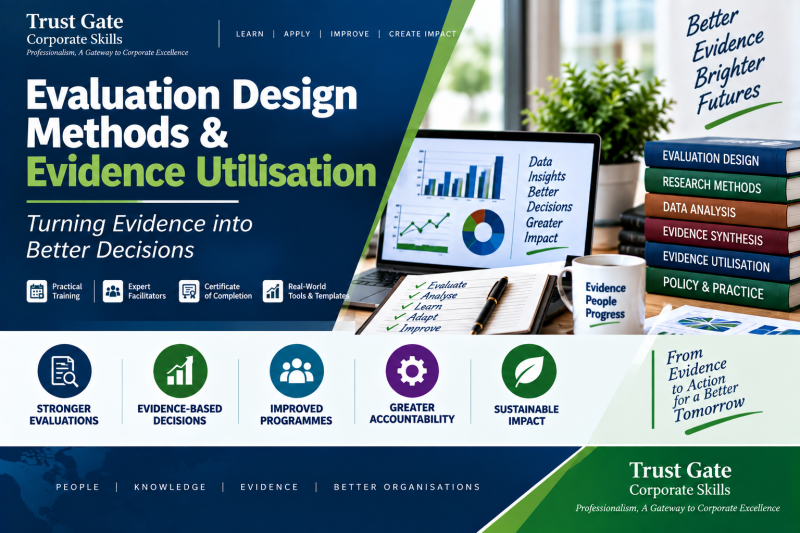
Evaluation Design Methods and Evidence Utilisation: Turning Evidence into Better Decisions
In many organisations, decisions are made every day about programmes, projects, policies, budgets and services. But an important question is often overlooked: How do we know that what we are doing is actually working? Evaluation is much more than collecting data at the end of a project and producing a report. A well-designed evaluation helps an organisation understand what worked, what did not work, why particular results were achieved, who benefited, what could have been done differently, and what should happen next. As organisations face increasing pressure to demonstrate results, justify the use of resources and make evidence-informed decisions, the ability to design rigorous evaluations and use evidence effectively has become an increasingly important professional capability.
Why Evaluation Matters More Than Ever
Imagine an organisation implementing a three-year community development programme. Significant financial and human resources are invested, activities are completed and reports are produced every year. At the end of the programme, the organisation can easily report the number of people trained, meetings held, materials distributed or facilities constructed. But those figures do not necessarily answer the most important questions.
Did the programme make a difference?
Did participants actually acquire new skills? Did those skills change behaviour? Did household incomes improve? Did the intervention address the original problem? Were there unintended effects? Was the programme cost-effective? And what lessons should inform the next programme? These are evaluation questions. Good evaluation moves an organisation from simply asking “What did we do?” to asking “What changed, why did it change, and what should we do differently?”
The Difference Between Data and Evidence
One of the challenges organisations face is assuming that having large amounts of data automatically means they have useful evidence which does not. An organisation may have thousands of survey responses, financial records, monitoring reports and performance indicators. However, if the data was poorly collected, inadequately analysed or disconnected from the evaluation questions, it may provide little basis for sound decision-making. Data becomes meaningful evidence when it is appropriately collected, analysed, interpreted and connected to a decision or action. This is why evaluation professionals need more than data-collection skills. They need to understand research design, methodology, measurement, analysis, interpretation and evidence utilisation.
Common Problems with Evaluation
1. Unclear evaluation questions
· An evaluation can become difficult when nobody has clearly defined what the evaluation is expected to establish.
· Without clear questions, data collection can become excessive, expensive and unfocused.
2. Weak evaluation design
· A poorly designed evaluation may make it difficult to determine whether observed changes are actually associated with the intervention.
3. Choosing inappropriate methods
· Different evaluation questions require different approaches.
· Quantitative methods, qualitative methods and mixed-methods designs each have different strengths and limitations.
4. Poor-quality data
· Incomplete responses, inconsistent measurement, weak sampling procedures and poorly designed instruments can undermine the credibility of evaluation findings.
5. Difficulty demonstrating outcomes and impact
· Counting activities is relatively easy.
· Demonstrating meaningful changes in knowledge, behaviour, institutional performance, livelihoods or other outcomes is much more demanding.
6. Findings that are never used
· Perhaps one of the biggest challenges is producing an excellent evaluation report that ultimately sits on a shelf.
· The real value of evaluation emerges when findings influence policy, programme design, resource allocation, management decisions and future interventions.
Moving Beyond Basic Monitoring
Monitoring asks questions such as:
- Are activities being implemented?
- Are targets being achieved?
- Are resources being used as planned?
- Are outputs being delivered?
Evaluation goes further and asks the following questions:
- Why did the results occur?
- What difference did the intervention make?
- Was the intervention relevant and effective?
- What factors influenced the outcomes?
- Were there unintended consequences?
- What lessons can be applied elsewhere?
The Importance of Advanced Evaluation Design
A strong evaluation begins long before data collection. It starts with understanding the programme, its objectives, theory of change, intended outcomes and the decisions that the evaluation is expected to support.
Evaluation design may involve developing:
- Evaluation questions
- Evaluation frameworks
- Theories of change
- Logic models
- Results frameworks
- Indicators
- Evaluation matrices
- Sampling strategies
- Data-collection instruments
- Analytical frameworks
- Evidence-synthesis approaches
The design should ensure that the methods selected are appropriate for the questions being asked. For example, if an organisation wants to understand how beneficiaries experienced a programme, qualitative approaches may provide valuable insights. If it wants to measure the magnitude of change across a large population, quantitative methods may be more appropriate. In many situations, a mixed-methods approach can provide a more comprehensive understanding.The important principle is not to choose a method simply because it is familiar. The method should serve the evaluation question.
From Evaluation Findings to Organisational Learning
Producing findings is only part of the evaluation process. The bigger challenge is turning findings into learning and action. An evaluation might reveal that a programme is achieving strong results in one region but producing weaker results elsewhere. Instead of simply recording the difference, managers can investigate why the results vary. Implementation capacity differs. Perhaps local conditions are different. Perhaps one delivery model is more effective than another. These insights can then inform future programme design and this is where evidence utilisation becomes critical because evidence should help organisations:
Learn → Decide → Adapt → Improve → Demonstrate Results
Evidence-Based Decision-Making
Evidence utilisation is not about replacing professional judgement with numbers.Good decisions often require a combination of:
- credible evidence,
- professional expertise,
- stakeholder perspectives,
- contextual understanding,
- organisational priorities,
- available resources and
- practical considerations.
The purpose of evaluation is therefore not simply to generate more information. It is to generate useful knowledge that improves decisions.