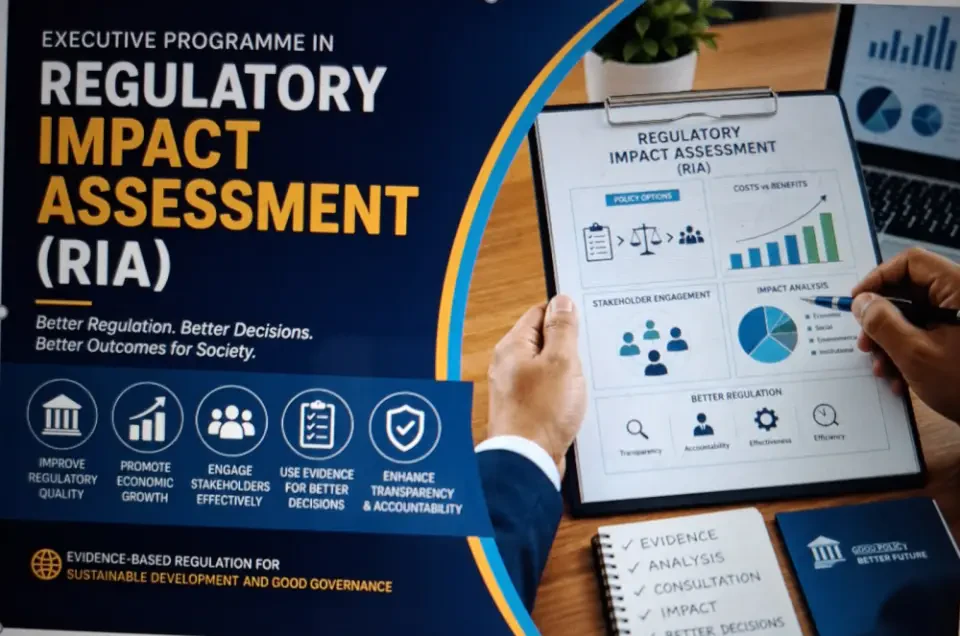
Executive Programme in Regulatory Impact Assesment (RIA) Course
The Executive Programme in Regulatory Impact Assesment (RIA) Course is a 10-day professional training programme delivered in-person in Compliance, ending with a TrustGate Corporate Skills certificate of completion.
High-quality regulation is a cornerstone of economic growth, investor confidence, good governance, and sustainable development. Around the world, governments and regulatory institutions are increasingly required to ensure that new and existing regulations are evidence-based, p...
Last updated
Course Overview
Learning Objectives
- Apply internationally recognized Regulatory Impact Assessment principles and methodologies in policy and regulatory development.
- Conduct evidence-based assessments of the economic, social, environmental, and institutional impacts of proposed regulations.
- Design effective stakeholder engagement and public consultation strategies that enhance regulatory legitimacy and transparency.
- Apply analytical tools including cost-benefit analysis, cost-effectiveness analysis, and risk assessment to support regulatory decision-making.
- Prepare comprehensive Regulatory Impact Assessment reports that inform policy formulation and legislative processes.
- Develop regulatory monitoring, evaluation, and post-implementation review frameworks for continuous regulatory improvement.
- Explain the principles, frameworks, and importance of Regulatory Impact Assessment in evidence-based policymaking.
- Identify regulatory problems, policy gaps, and objectives requiring government or institutional intervention.
- Evaluate alternative regulatory and non-regulatory options using cost-benefit analysis and economic impact assessment.
- Assess the potential economic, social, environmental, and institutional impacts of proposed regulations.
Course Content
- Evolution, purpose and importance of Regulatory Impact Assessment.
- Principles of Better Regulation and evidence-based policymaking.
- International RIA frameworks and regulatory excellence standards.
- Benefits of RIA for governance, economic growth and public value.
- Principles of regulatory governance and accountability.
- Institutional arrangements, mandates and regulatory responsibilities.
- Regulatory oversight mechanisms and quality assurance institutions.
- The regulatory life cycle and coordination across institutions.
- Identification and definition of regulatory problems and policy gaps.
- Root cause analysis and assessment of underlying issues.
- Baseline assessment and analysis of existing conditions.
- Formulation of clear, measurable and evidence-based policy objectives.
- Identification of regulatory, non-regulatory and alternative policy options.
- Comparative policy analysis and assessment of policy feasibility.
- Data collection, evidence quality assessment and policy intelligence.
- Innovation-friendly regulation and evidence-based policy selection.
- Economic impact assessment, business costs and productivity effects.
- Competition assessment, investment implications and market impacts.
- Social inclusion, employment effects and gender considerations.
- Consumer protection and distributional impacts across stakeholder groups.
- Environmental sustainability and assessment of environmental impacts.
- Climate change considerations and natural resource implications.
- Institutional capacity, operational implications and implementation readiness.
- Sustainable development and assessment of long-term policy outcomes.
- Identification and classification of regulatory costs and benefits.
- Economic valuation techniques and monetization of impacts.
- Discounting principles, net benefits and cost-effectiveness analysis.
- Decision criteria, resource optimisation and performance indicators.
- Identification of regulatory risks, hazards and uncertainties.
- Analysis of risk likelihood, severity and potential consequences.
- Risk evaluation, prioritization and regulatory risk acceptability.
- Risk mitigation strategies and decision-making under uncertainty.
- Stakeholder identification, classification and mapping.
- Analysis of stakeholder interests, expectations and concerns.
- Assessment of stakeholder influence, power and potential impact.
- Development of stakeholder engagement plans and participation strategies.
- Public consultation methods and inclusive participation mechanisms.
- Digital engagement tools and accessible communication channels.
- Regulatory communication, transparency and management of stakeholder expectations.
- Consultation documentation, feedback analysis and reporting.
- Principles of effective regulatory design and legal proportionality.
- Performance-based, outcome-focused and principles-based regulation.
- Regulatory flexibility, innovation and adaptability to changing conditions.
- Balancing regulatory objectives, compliance burdens and public interest.
- Legislative drafting principles, structure and regulatory clarity.
- Legal consistency, enforceability and alignment with existing legislation.
- Compliance planning, implementation guidance and stakeholder support.
- Regulatory enforcement models, compliance monitoring and sanctions.
- Regulatory quality standards and assessment criteria.
- Internal review processes and quality assurance procedures.
- Independent oversight, scrutiny and validation of regulatory proposals.
- Continuous improvement and institutional quality management.
- Administrative simplification, red tape reduction and regulatory burden management.
- Business-friendly regulation, regulatory efficiency and improved service delivery.
- Digital regulation, smart regulation and Regulatory Technology (RegTech).
- Data-driven regulation, digital innovation and regulatory transformation.
- Development of regulatory performance indicators and measurement frameworks.
- Compliance monitoring, enforcement tracking and performance assessment.
- Regulatory data collection, reporting and information management.
- Regulatory dashboards, performance analysis and evidence-based decision-making.
- Post-implementation review methods and regulatory evaluation frameworks.
- Measurement of regulatory effectiveness, efficiency and intended outcomes.
- Lessons learned, identification of implementation gaps and corrective action.
- Regulatory revision, adaptive regulation and international benchmarking.
- Economic regulation, competition and financial market oversight.
- Social sector regulation, public services and consumer protection.
- Environmental regulation, climate considerations and natural resource management.
- Infrastructure, utilities and sector-specific regulatory challenges.
- Behavioural insights and Behavioural economics in regulatory design.
- Citizen-centered regulation, public value and responsive governance.
- Artificial intelligence, digital innovation and future-ready regulation.
- Cross-border regulatory cooperation, harmonization and regulatory agility
- RIA report structure, content requirements and analytical framework.
- Technical writing, presentation of evidence and interpretation of findings.
- Documentation of alternatives, impact analysis and stakeholder consultation.
- Formulation of evidence-based recommendations and implementation proposals.
- Conducting a real-world RIA simulation using a selected regulatory problem.
- Preparing and presenting an RIA report with supporting evidence.
- Peer review, quality assessment and incorporation of facilitator feedback.
- Developing institutional implementation roadmaps and individual action plans.
Who Should Attend?
- Government Ministries, Departments and Agencies (MDAs)
- Regulatory Authorities and Independent Commissions
- Parliamentarians, Legislative Drafters and Policy Makers
- Senior Public Sector Executives and Programme Managers
- Legal, Compliance, Risk and Corporate Affairs Professionals
- Development Partners, International Organizations and NGOs
- Researchers, Economists, Consultants and Policy Analysts
Training Methodology
- Interactive lectures
- Facilitated discussions
- Case study analysis
- Practical workshops
- Hands-on exercises
- Simulation exercises
- Stakeholder consultation role-plays
- Policy and regulatory review
- Group work and team projects
- Problem-based learning
- Expert panel discussions
- Individual assignments
- Participant presentations
Your facilitator

Mr Elisha Otieno
MERL Specialist and Professional , statistician, Data & AI Analytics Consultant, Trainer with 20+ years of experience across statistics, data analytics, monitoring, evaluation, research, learning, data systems and digital transformation. Experienced in translating complex analytical, AI and MERL concepts into practical, decision-oriented solutions for government institutions, financial institutions, NGOs, international development organisations, research teams and professional audiences. Has del
View full profileIs this course for you?
Level: Advanced
Problems this course solves
- Poorly Designed Policies and Regulations: Equips executives with skills to identify policy gaps, assess regulatory alternatives, and develop evidence-based regulations that address real problems without creating unnecessary burdens.
- High Costs of Compliance and Regulatory Burden: Helps executives evaluate the financial and administrative costs of regulations on businesses, government institutions, investors, and citizens, enabling them to design cost-effective regulatory frameworks.
- Inadequate Evidence for Policy: Decisions Strengthens the ability of executives to use data, economic analysis, stakeholder consultations, and cost-benefit analysis to predict the likely effects of proposed regulations before implementation.
- Unintended Consequences of Regulations: Enables executives to anticipate risks such as reduced investment, market distortions, job losses, and barriers to innovation, while developing mitigation measures and monitoring regulatory outcomes.
What's Included
Certification
Certificate in Regulatory Impact Assessment (RIA)
Issued by: TRUSTGATE CORPORATE SKILLS
Frequently Asked Questions
How long is the Executive Programme in Regulatory Impact Assesment (RIA) Course training?
The Executive Programme in Regulatory Impact Assesment (RIA) Course runs for 10 Days. Each day combines expert-led teaching with practical, hands-on exercises so participants can apply what they learn immediately.
Is the Executive Programme in Regulatory Impact Assesment (RIA) Course delivered online or in-person?
This course is delivered in person (scheduled venues include Kigali, Nairobi, Mombasa, Dar es Salaam), or in-house at your organisation.
How much does the Executive Programme in Regulatory Impact Assesment (RIA) Course cost?
The in-person fee is US$2,800 per person. In-person fees depend on the participant's country; the pricing card on this page shows the fee for yours.
When is the next Executive Programme in Regulatory Impact Assesment (RIA) Course training?
A session is running now, from 2 November 2026 to 13 November 2026 in Kigali, Rwanda. The next one runs from 16 November 2026 to 27 November 2026 in Mombasa, Kenya. You can also request a custom date or an in-house session for your team.
Do I get a certificate after completing the Executive Programme in Regulatory Impact Assesment (RIA) Course?
Yes. Participants who complete the Executive Programme in Regulatory Impact Assesment (RIA) Course receive a certificate of completion from TRUSTGATE CORPORATE SKILLS.
What will I learn in the Executive Programme in Regulatory Impact Assesment (RIA) Course?
Key learning outcomes include: Apply internationally recognized Regulatory Impact Assessment principles and methodologies in policy and regulatory development; Conduct evidence-based assessments of the economic, social, environmental, and institutional impacts of proposed regulations; Design effective stakeholder engagement and public consultation strategies that enhance regulatory legitimacy and transparency; Apply analytical tools including cost-benefit analysis, cost-effectiveness analysis, and risk assessment to support regulatory decision-making; Prepare comprehensive Regulatory Impact Assessment reports that inform policy formulation and legislative processes.