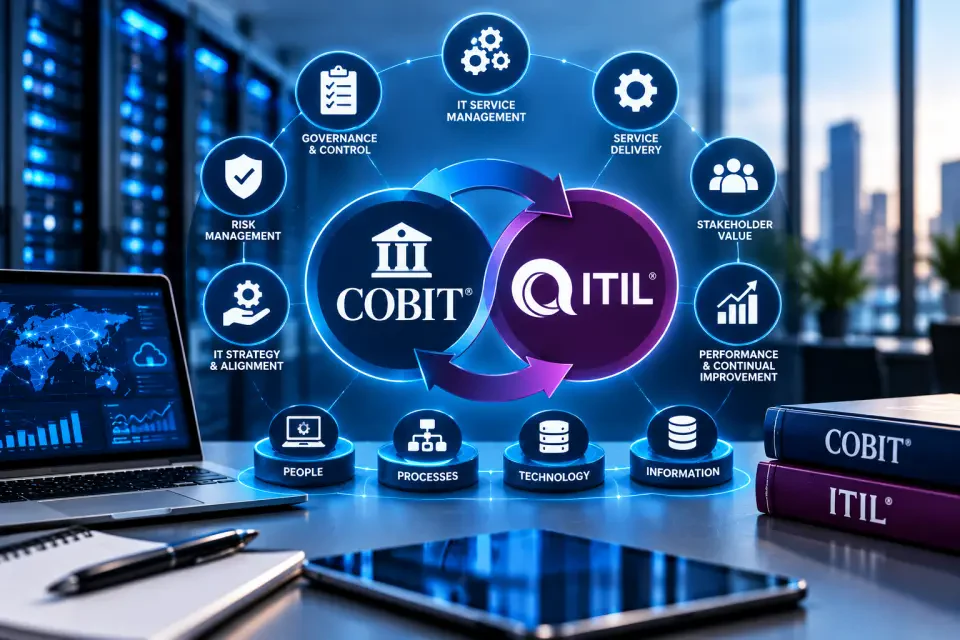
ICT Governance and IT Service Management (COBIT and ITIL) Course
The ICT Governance and IT Service Management (COBIT and ITIL) Course is a 5-day professional training programme delivered in-person or online in ICT-Information & Communication Technology, ending with a TrustGate Corporate Skills certificate of completion.
Organisations spend heavily on ICT and often cannot show what it delivered. This course covers the two frameworks that answer that: COBIT for governing ICT as a business asset, and ITIL for running IT services day to day.
Last updated
Course Overview
Learning Objectives
- Explain the difference between governing ICT and managing it
- Apply COBIT principles to decision rights, accountability and ICT investment
- Set up an ICT steering committee that functions
- Design and run the core ITIL service management processes
- Define service levels and measure them honestly
- Run change, incident and problem management so releases stop breaking systems
- Manage the ICT asset register, licences and the budget
- Prepare for an internal or external ICT audit
- Build an ICT governance improvement roadmap
Course Content
- Why ICT governance exists
- COBIT principles and governance objectives
- Decision rights: who decides what about technology
- The ICT steering committee and its mandate
- Aligning ICT plans with the organisational strategy
- Common governance failures
- Building an ICT strategic plan that survives contact with reality
- Prioritising projects and systems
- Business cases for ICT investment
- Budgeting capital and recurrent ICT costs
- Benefit tracking after a system goes live
- Retiring systems nobody will admit to owning
- ITIL service management concepts
- Building a service catalogue
- Service desk design and tiering
- Request fulfilment workflows
- Roles, responsibilities and escalation paths
- Right-sizing processes for a small ICT team
- Writing service level agreements people can meet
- Operational level agreements with internal teams
- Underpinning contracts with suppliers
- Metrics that reflect user experience
- Reporting service performance honestly
- Handling persistent breaches
- Incident management and prioritisation
- Major incident handling and communication
- Problem management and root cause analysis
- Change control, approval and the change calendar
- Emergency changes and back-out plans
- Release and deployment discipline
- Asset registers, licences and warranties
- Configuration management and dependency mapping
- Capacity and availability planning
- Backup, disaster recovery and continuity testing
- Shadow IT and unapproved cloud services
- Managing end-of-life hardware and software
- What ICT auditors look for and why
- Evidence, documentation and traceability
- Common audit findings and how to close them
- Maturity assessment of your ICT function
- Prioritising improvements with limited resources
- Reporting ICT performance to management and the board
Who Should Attend?
- ICT managers, heads of ICT and systems administrators
- Service desk and IT support supervisors
- Internal auditors reviewing ICT
- Risk and compliance officers covering technology
- Finance managers who approve ICT budgets
- Public sector ICT officers
Training Methodology
- Governance structure design workshop
- Process mapping for incident, change and problem management
- Service level agreement drafting clinic
- Audit readiness self-assessment
- Case studies from public sector and corporate ICT functions
- A maturity assessment of your own ICT function
Is this course for you?
Level: Intermediate
Problems this course solves
- Large ICT spend with no way to show the value delivered
- Systems bought by departments independently, then left for IT to support
- Service failures with no agreed response times and nobody accountable
- Changes pushed to production on a Friday that break things on Monday
- The same incidents recurring because nobody investigates root cause
- Audit findings on ICT that repeat every year
- No asset register, so licences, warranties and hardware go untracked
Recommended prerequisites
- An ICT management, systems administration, audit or operations role
- Familiarity with how your organisation's main systems are supported
- No prior COBIT or ITIL certification required
This course is NOT designed for
- Those preparing to sit the official ITIL or COBIT certification exams
- Technical engineers seeking hands-on infrastructure or network training
- Organisations wanting a software selection or procurement exercise
What's Included
Certification
Certificate in ICT Governance and IT Service Management
Issued by: TRUSTGATE CORPORATE SKILLS
Frequently Asked Questions
How long is the ICT Governance and IT Service Management (COBIT and ITIL) Course training?
The ICT Governance and IT Service Management (COBIT and ITIL) Course runs for 5 Days. Each day combines expert-led teaching with practical, hands-on exercises so participants can apply what they learn immediately.
Is the ICT Governance and IT Service Management (COBIT and ITIL) Course delivered online or in-person?
This course is delivered in person (scheduled venues include Dar es Salaam, Kigali, Nairobi, Mombasa), live online, or in-house at your organisation.
How much does the ICT Governance and IT Service Management (COBIT and ITIL) Course cost?
The fee is US$600 per person online and US$1,400 per person in person. In-person fees depend on the participant's country; the pricing card on this page shows the fee for yours.
When is the next ICT Governance and IT Service Management (COBIT and ITIL) Course training?
A session is running now, from 2 November 2026 to 6 November 2026 in Dar es Salaam, Tanzania. The next one runs from 9 November 2026 to 13 November 2026 in Kigali, Rwanda. You can also request a custom date or an in-house session for your team.
Do I get a certificate after completing the ICT Governance and IT Service Management (COBIT and ITIL) Course?
Yes. Participants who complete the ICT Governance and IT Service Management (COBIT and ITIL) Course receive a certificate of completion from TRUSTGATE CORPORATE SKILLS.
What will I learn in the ICT Governance and IT Service Management (COBIT and ITIL) Course?
Key learning outcomes include: Explain the difference between governing ICT and managing it; Apply COBIT principles to decision rights, accountability and ICT investment; Set up an ICT steering committee that functions; Design and run the core ITIL service management processes; Define service levels and measure them honestly.