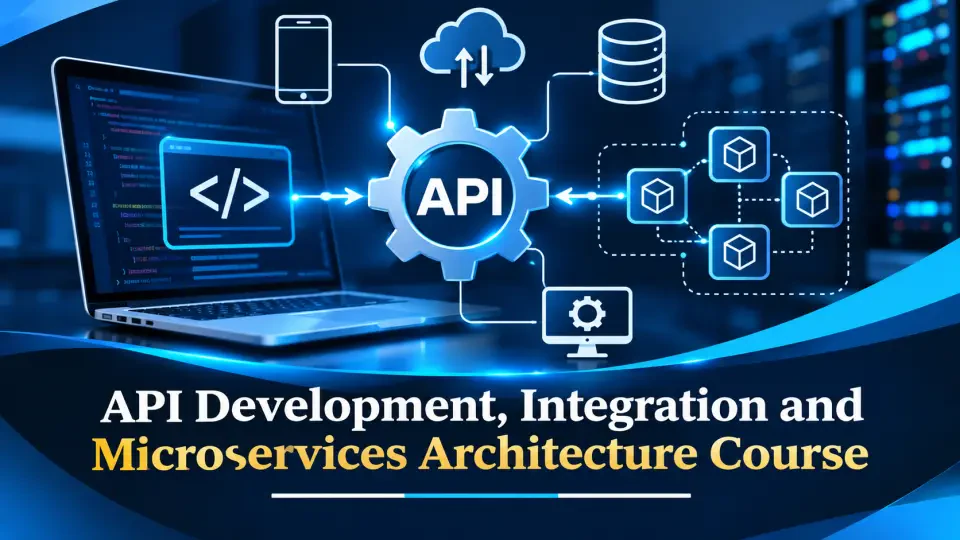
API Development, Integration and Microservices Architecture Course
The API Development, Integration and Microservices Architecture Course is a 5-day professional training programme delivered in-person or online in ICT-Information & Communication Technology, ending with a TrustGate Corporate Skills certificate of completion.
This programme equips software developers and IT professionals with the skills required to design, build, secure and manage application programming interfaces and distributed software services. It covers RESTful APIs, HTTP communication, JSON data exchange, API authentication,...
Course Overview
Learning Objectives
- Explain API concepts, communication protocols and integration architectures.
- Design RESTful APIs using appropriate resource structures and HTTP methods.
- Develop API endpoints with input validation and error handling.
- Implement authentication, authorization and basic API security controls.
- Integrate applications with internal and external services.
- Explain microservices architecture and its operational trade-offs.
- Test, document, monitor and maintain APIs and distributed services
Course Content
- API concepts, purposes and business applications.
- Client-server communication and request-response workflows.
- REST, SOAP, webhooks and event-driven integration concepts.
- API gateways, service boundaries and integration architecture patterns.
- HTTP methods, status codes, headers and request bodies.
- Resource naming, URI design and endpoint organization.
- JSON data structures, serialization and response formats.
- Idempotency, pagination, filtering and consistent API behaviour.
- Setting up API development environments and frameworks.
- Building endpoints, routes, controllers and request handlers.
- Input validation, business logic and response generation.
- Exception handling, error responses and application logging.
- Designing data models for API-driven applications.
- Connecting APIs to relational databases.
- CRUD operations, transactions and data consistency.
- Database validation, query efficiency and error management.
- Authentication, authorization and access control principles.
- API keys, session-based authentication and token-based approaches.
- OAuth 2.0 and OpenID Connect fundamentals.
- Rate limiting, input validation, secrets management and common API vulnerabilities.
- API documentation principles and OpenAPI specifications.
- Testing endpoints, requests, responses and error conditions.
- API versioning, backward compatibility and deprecation.
- Automated testing, contract testing fundamentals and regression checks.
- Integrating enterprise applications and third-party services.
- Data mapping, transformation and synchronization.
- Webhooks, callbacks and event-driven communication.
- Retry policies, timeout handling and integration error recovery.
- Monolithic applications versus microservices.
- Service decomposition, bounded contexts and domain-driven design fundamentals.
- Synchronous and asynchronous service communication.
- Service ownership, independent deployment and architectural trade-offs.
- Service discovery, API gateways and routing.
- Containers and deployment concepts for distributed services.
- Centralized logging, monitoring, tracing and performance analysis.
- Resilience patterns, including timeouts, retries and circuit breakers.
- Defining integration requirements and designing an API contract.
- Developing endpoints and integrating a database or external service.
- Implementing authentication, documentation and automated tests.
- Presenting an integration solution with deployment and monitoring recommendations.
Who Should Attend?
- Software developers and application engineers.
- Back-end and full-stack developers.
- Systems analysts and integration specialists.
- ICT professionals responsible for enterprise applications.
- Cloud engineers and DevOps practitioners.
- Database and application support professionals.
- Technical architects and software consultants.
- Professionals involved in digital platform integration.
Training Methodology
- Instructor-led technical demonstrations.
- Hands-on API development laboratories.
- API testing using suitable development tools.
- Integration design workshops.
- Authentication and security exercises.
- Microservices architecture case studies.
- A practical project involving API development and system integration.
Is this course for you?
Level: Intermediate
Problems this course solves
- Disconnected applications: Develops skills for exchanging data between internal systems, external platforms and third-party services.
- Inconsistent API design: Introduces standardized resource structures, response formats, versioning and documentation.
- Insecure application integrations: Strengthens authentication, authorization, validation and API security practices.
- Difficult-to-maintain distributed systems: Explains microservices design, service communication, monitoring and resilience.
What's Included
Certification
Certificate in API Development, Integration and Microservices Architecture
Issued by: TRUSTGATE CORPORATE SKILLS
Frequently Asked Questions
How long is the API Development, Integration and Microservices Architecture Course training?
The API Development, Integration and Microservices Architecture Course runs for 5 Days. Each day combines expert-led teaching with practical, hands-on exercises so participants can apply what they learn immediately.
Is the API Development, Integration and Microservices Architecture Course delivered online or in-person?
This course is delivered in person (scheduled venues include Nairobi, Kigali, Lusaka, Dar es Salaam), live online, or in-house at your organisation.
How much does the API Development, Integration and Microservices Architecture Course cost?
The fee is US$600 per person online and US$1,400 per person in person. In-person fees depend on the participant's country; the pricing card on this page shows the fee for yours.
When is the next API Development, Integration and Microservices Architecture Course training?
A session is running now, from 23 November 2026 to 27 November 2026 in Nairobi, Kenya. The next one runs from 30 November 2026 to 5 December 2026 in Nairobi, Kenya. You can also request a custom date or an in-house session for your team.
Do I get a certificate after completing the API Development, Integration and Microservices Architecture Course?
Yes. Participants who complete the API Development, Integration and Microservices Architecture Course receive a certificate of completion from TRUSTGATE CORPORATE SKILLS.
What will I learn in the API Development, Integration and Microservices Architecture Course?
Key learning outcomes include: Explain API concepts, communication protocols and integration architectures; Design RESTful APIs using appropriate resource structures and HTTP methods; Develop API endpoints with input validation and error handling; Implement authentication, authorization and basic API security controls; Integrate applications with internal and external services.