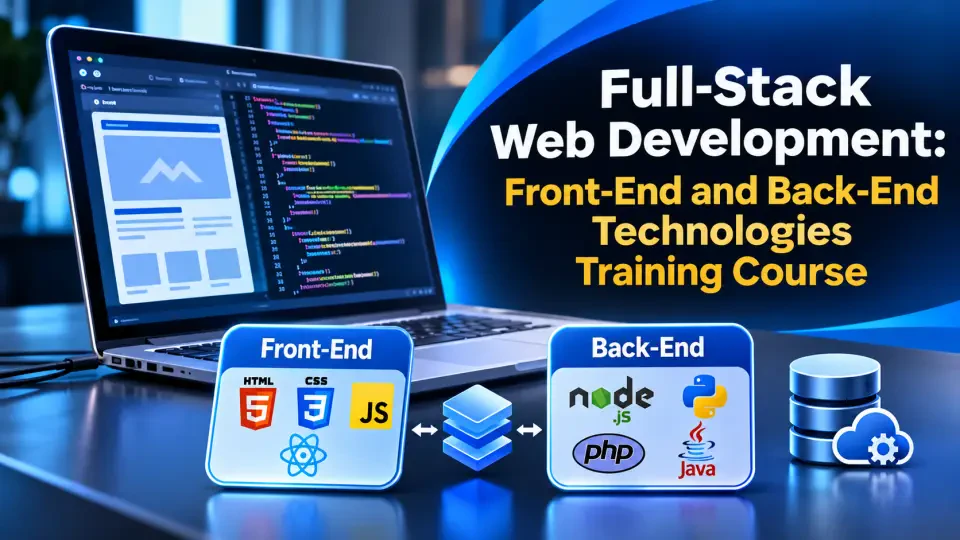
Full-Stack Web Development: Front-End and Back-End Technologies Training Course
The Full-Stack Web Development: Front-End and Back-End Technologies Training Course is a 5-day professional training programme delivered in-person or online in ICT-Information & Communication Technology, ending with a TrustGate Corporate Skills certificate of completion.
This programme equips participants with the technical skills required to design, develop, test and deploy modern web applications. It covers front-end development, back-end programming, database integration, application architecture, responsive design, authentication, security...
Course Overview
Learning Objectives
- Explain web development architecture and the roles of front-end and back-end technologies.
- Build responsive web interfaces using HTML, CSS and JavaScript.
- Develop interactive applications using a modern front-end framework.
- Create server-side applications and integrate relational databases.
- Develop and consume RESTful APIs.
- Apply version control, testing, security and debugging practices.
- Deploy and maintain a functional full-stack web application.
Course Content
- Web technologies, internet protocols and client-server communication.
- Front-end, back-end and full-stack development responsibilities.
- Web application architecture and request-response workflows.
- Development environments, browsers, developer tools and project setup.
- HTML document structure and semantic elements.
- Forms, tables, links, lists and multimedia integration.
- Accessibility principles and semantic markup.
- Form validation and structured content organization.
- CSS selectors, properties, inheritance and cascading rules.
- Layout design using Flexbox and CSS Grid.
- Responsive design, media queries and mobile-first development.
- Typography, visual hierarchy, reusable styles and interface consistency.
- Variables, data types, operators and control structures.
- Functions, arrays, objects and modular programming.
- DOM manipulation, events and form interactions.
- Asynchronous JavaScript, promises, fetch and error handling.
- Component-based architecture and reusable interface elements.
- State management, properties and event handling.
- Routing, forms and client-side application navigation.
- Front-end API integration and interface testing.
- Server-side programming concepts and application frameworks.
- Routing, controllers, middleware and request handling.
- Business logic, input validation and error management.
- Environment variables, configuration and application logging.
- Relational database concepts and data modelling.
- SQL queries, tables, relationships and constraints.
- Database connectivity and application data access.
- Data validation, transactions and database error handling.
- RESTful API principles, HTTP methods and status codes.
- JSON data exchange and API request handling.
- Authentication, authorization and session management.
- Secure input handling, access controls and common web vulnerabilities.
- Git fundamentals, repositories, branching and collaboration.
- Unit testing, integration testing and debugging.
- Environment configuration, build processes and deployment.
- Application monitoring, maintenance and performance optimization
- Requirements analysis, feature planning and interface prototyping.
- Developing front-end components and server-side functionality.
- Integrating databases, APIs and user authentication.
- Testing, deploying and presenting a complete web application.
Who Should Attend?
- Aspiring web developers and software engineers.
- ICT officers and technical support professionals.
- Computer science and information technology students.
- Programmers seeking to expand into full-stack development.
- Digital product developers and technology entrepreneurs.
- Business application developers.
- Professionals transitioning into software development.
- IT consultants involved in website and application projects.
Training Methodology
- Instructor-led technical demonstrations.
- Hands-on coding laboratories.
- Guided front-end and back-end development exercises.
- Database and API integration workshops.
- Code review and debugging sessions.
- Collaborative software development projects.
- Practical assessment through a complete web application.
Is this course for you?
Level: Intermediate
Problems this course solves
- Dependence on separate developers for different application components: Develops the ability to work across front-end, back-end and database layers.
- Poor user experience across devices: Builds skills in responsive design and interactive interface development.
- Disconnected business systems: Introduces APIs and database integration for exchanging information between applications.
- Difficult application maintenance and deployment: Establishes practical skills in testing, version control, security and deployment.
What's Included
Certification
Certificate in Full-Stack Web Development: Front-End and Back-End Technologies
Issued by: TRUSTGATE CORPORATE SKILLS
Frequently Asked Questions
How long is the Full-Stack Web Development: Front-End and Back-End Technologies Training Course training?
The Full-Stack Web Development: Front-End and Back-End Technologies Training Course runs for 5 Days. Each day combines expert-led teaching with practical, hands-on exercises so participants can apply what they learn immediately.
Is the Full-Stack Web Development: Front-End and Back-End Technologies Training Course delivered online or in-person?
This course is delivered in person (scheduled venues include Nairobi, Mombasa, Kigali, Kampala), live online, or in-house at your organisation.
How much does the Full-Stack Web Development: Front-End and Back-End Technologies Training Course cost?
The fee is US$600 per person online and US$1,400 per person in person. In-person fees depend on the participant's country; the pricing card on this page shows the fee for yours.
When is the next Full-Stack Web Development: Front-End and Back-End Technologies Training Course training?
The next scheduled session runs from 23 November 2026 to 27 November 2026 in Nairobi, Kenya. You can also request a custom date or an in-house session for your team.
Do I get a certificate after completing the Full-Stack Web Development: Front-End and Back-End Technologies Training Course?
Yes. Participants who complete the Full-Stack Web Development: Front-End and Back-End Technologies Training Course receive a certificate of completion from TRUSTGATE CORPORATE SKILLS.
What will I learn in the Full-Stack Web Development: Front-End and Back-End Technologies Training Course?
Key learning outcomes include: Explain web development architecture and the roles of front-end and back-end technologies; Build responsive web interfaces using HTML, CSS and JavaScript; Develop interactive applications using a modern front-end framework; Create server-side applications and integrate relational databases; Develop and consume RESTful APIs.