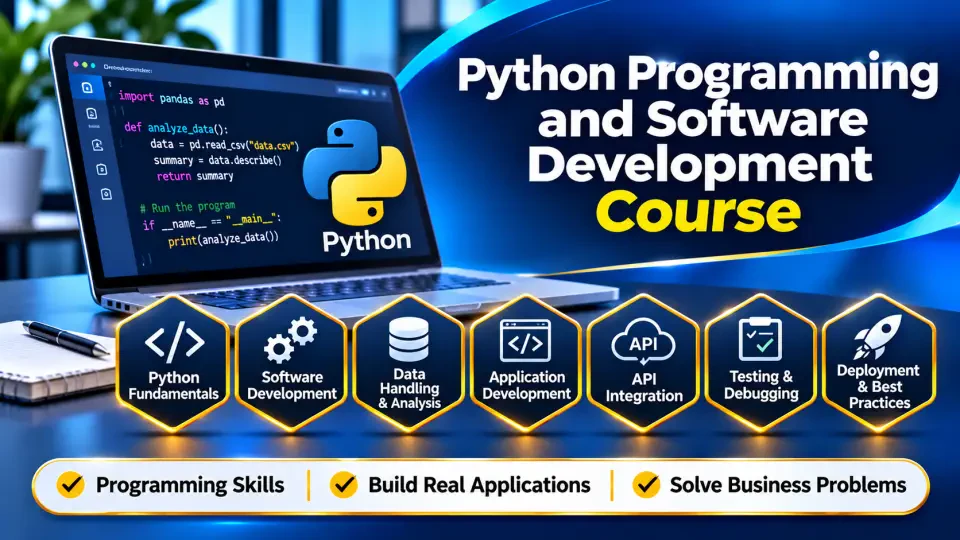
Python Programming and Software Development Course
The Python Programming and Software Development Course is a 5-day professional training programme delivered in-person or online in ICT-Information & Communication Technology, ending with a TrustGate Corporate Skills certificate of completion.
This programme introduces participants to Python programming and develops their ability to design, write, test and maintain software applications. It covers programming fundamentals, data structures, functions, object-oriented programming, file handling, error management, data...
Course Overview
Learning Objectives
- Explain programming concepts and the structure of Python applications.
- Write Python programs using variables, control structures and functions.
- Manipulate lists, dictionaries, sets, tuples and other data structures.
- Apply object-oriented programming principles.
- Work with files, databases and external APIs.
- Test, debug and document Python applications.
- Develop a functional Python project using appropriate software development practices.
Course Content
- Programming concepts and applications of Python.
- Installing Python, selecting an IDE and configuring the development environment.
- Variables, data types, operators and expressions.
- Input, output, comments and basic program structure
- Conditional statements and decision-making.
- For loops, while loops and iteration.
- Loop control, nested structures and logical conditions.
- Writing algorithms and solving programming problems.
- Strings, indexing, slicing and string operations.
- Lists, tuples and common collection operations.
- Dictionaries, sets and key-value data management.
- Iteration, comprehensions and collection transformations
- Defining functions, parameters and return values.
- Positional, keyword and default arguments.
- Scope, reusable functions and modular code organization.
- Importing modules, packages and using the Python standard library.
- Classes, objects, attributes and methods.
- Constructors and object initialization.
- Encapsulation, inheritance and polymorphism.
- Designing reusable classes and organizing larger applications.
- Reading and writing text files.
- Processing CSV, JSON and structured data files.
- Exception handling and defensive programming.
- Logging, file management and robust error reporting.
- Relational database concepts and SQL fundamentals.
- Connecting Python applications to databases.
- Sending HTTP requests and consuming REST APIs.
- Processing JSON responses, handling errors and managing credentials.
- Virtual environments, dependencies and package management.
- Code style, naming conventions and documentation.
- Git fundamentals, version control and collaboration.
- Debugging techniques and application troubleshooting.
- Unit testing and automated test fundamentals.
- Test cases, assertions and handling edge cases.
- Input validation, secure coding and protection of credentials.
- Refactoring, code review and maintainability.
- Identifying requirements and designing a program solution.
- Developing modular application logic and data structures.
- Integrating files, databases or external APIs where appropriate.
- Testing, documenting and presenting a working Python application.
Who Should Attend?
- Beginners interested in software development.
- ICT officers and technical support professionals.
- Computer science and information technology students.
- Data analysts seeking programming skills.
- Business analysts and automation specialists.
- Software developers expanding their programming toolkit.
- Researchers and professionals working with data.
- Entrepreneurs developing digital business solutions.
Training Methodology
- Instructor-led demonstrations.
- Hands-on coding exercises.
- Guided programming laboratories.
- Debugging and problem-solving workshops.
- Small application development assignments.
- Code review and collaborative development exercises.
- Practical assessment through an integrated Python project.
Is this course for you?
Level: Intermediate
Problems this course solves
- Limited programming capability: Develops foundational skills for creating software and digital solutions.
- Repetitive manual tasks: Introduces Python scripts to automate file processing, calculations and routine workflows.
- Difficulty handling data and external systems: Teaches data structures, database connectivity and API integration.
- Poor software maintainability: Establishes good practices in modular programming, testing, debugging and documentation.
What's Included
Certification
Certificate in Python Programming and Software Development
Issued by: TRUSTGATE CORPORATE SKILLS
Frequently Asked Questions
How long is the Python Programming and Software Development Course training?
The Python Programming and Software Development Course runs for 5 Days. Each day combines expert-led teaching with practical, hands-on exercises so participants can apply what they learn immediately.
Is the Python Programming and Software Development Course delivered online or in-person?
This course is delivered in person (scheduled venues include Nairobi, Mombasa, Kigali, Johannesburg), live online, or in-house at your organisation.
How much does the Python Programming and Software Development Course cost?
The fee is US$600 per person online and US$1,400 per person in person. In-person fees depend on the participant's country; the pricing card on this page shows the fee for yours.
When is the next Python Programming and Software Development Course training?
The next scheduled session runs from 16 November 2026 to 20 November 2026 in Nairobi, Kenya. You can also request a custom date or an in-house session for your team.
Do I get a certificate after completing the Python Programming and Software Development Course?
Yes. Participants who complete the Python Programming and Software Development Course receive a certificate of completion from TRUSTGATE CORPORATE SKILLS.
What will I learn in the Python Programming and Software Development Course?
Key learning outcomes include: Explain programming concepts and the structure of Python applications; Write Python programs using variables, control structures and functions; Manipulate lists, dictionaries, sets, tuples and other data structures; Apply object-oriented programming principles; Work with files, databases and external APIs.