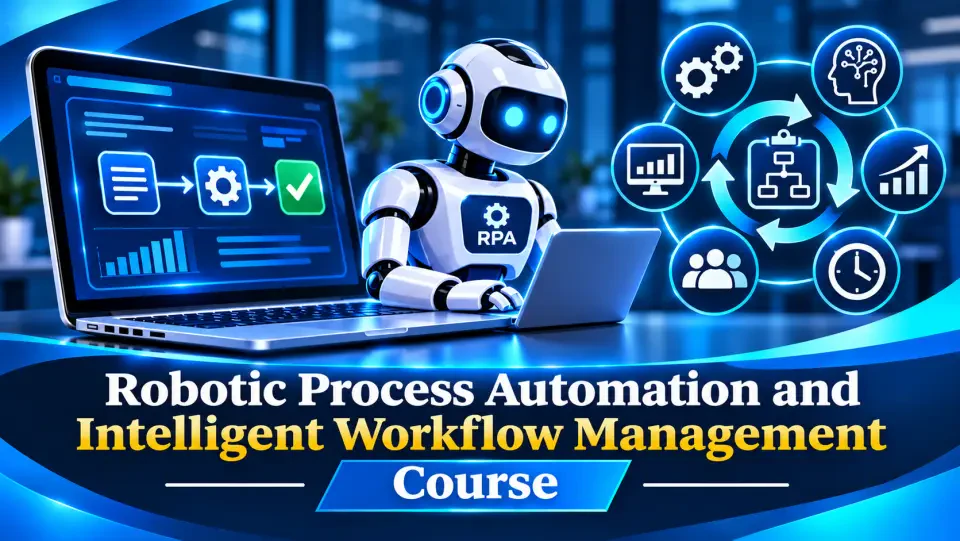
Robotic Process Automation and Intelligent Workflow Management Course
The Robotic Process Automation and Intelligent Workflow Management Course is a 5-day professional training programme delivered in-person or online in ICT-Information & Communication Technology, ending with a TrustGate Corporate Skills certificate of completion.
This programme develops the knowledge and practical skills required to automate repetitive, rule-based digital tasks using robotic process automation (RPA) and intelligent workflow technologies. It examines software bots, process discovery, automation design, desktop and web a...
Course Overview
Learning Objectives
- Explain RPA concepts, architectures and business applications.
- Identify and assess suitable processes for robotic automation.
- Design and build basic software bot workflows using appropriate tools.
- Apply selectors, variables, conditions and exception-handling techniques.
- Explain how document processing and AI can extend conventional automation.
- Test, monitor and maintain automated workflows.
- Evaluate automation benefits, risks, governance and return on investment.
Course Content
- RPA concepts, evolution and organizational applications.
- Attended, unattended and hybrid automation models.
- Software bots, orchestration platforms and execution environments.
- RPA benefits, limitations and comparison with traditional automation.
- Identifying repetitive, rule-based and high-volume activities.
- Process mapping, task observation and workflow documentation.
- Assessing process stability, complexity and automation suitability.
- Prioritizing opportunities using value, effort, risk and expected benefits.
- RPA platform components and development environments.
- Bot design, workflow sequences and reusable components.
- Application access, selectors and interaction methods.
- Bot execution, scheduling and orchestration fundamentals.
- Automating forms, menus, buttons and user interface interactions.
- Extracting and entering data in business applications.
- Browser automation, navigation and web element identification.
- Automating spreadsheets, files and routine office tasks.
- Variables, data types and data structures in automation.
- Conditions, loops and decision-based workflow execution.
- Processing spreadsheets, structured files and text records.
- Data validation, transformation and reconciliation.
- Identifying expected and unexpected workflow exceptions.
- Error handling, retries, timeouts and recovery procedures.
- Logging, screenshots and execution evidence.
- Designing resilient workflows and reducing bot failures.
- Differences between conventional RPA and intelligent automation.
- Optical character recognition and document data extraction.
- AI-assisted classification, text processing and information extraction.
- Confidence thresholds, human review and exception resolution.
- Testing bot logic, application interactions and output accuracy.
- Monitoring bot runs, queues, failures and execution history.
- Measuring throughput, processing time and error rates.
- Troubleshooting, bot maintenance and performance optimization.
- Access control, credentials and secure bot identities.
- Data privacy, confidentiality and information protection.
- Change management, audit trails and automation documentation.
- Bot ownership, operational controls and business continuity
- Selecting and documenting a business process for automation.
- Designing a bot workflow with defined inputs, actions and outputs.
- Testing the solution and documenting exceptions.
- Evaluating productivity gains, costs, risks and implementation priorities.
Who Should Attend?
- Business process improvement specialists.
- Operations and shared services professionals.
- Finance and accounting teams.
- Human resource and administrative officers.
- ICT professionals and software developers.
- Digital transformation and automation teams.
- Business analysts and process consultants.
- Professionals responsible for high-volume, repetitive administrative processes.
Training Methodology
- Instructor-led demonstrations.
- Process discovery and suitability assessment workshops.
- Hands-on automation exercises using suitable RPA tools.
- Bot development and debugging laboratories.
- Intelligent document processing demonstrations.
- Case studies involving business operations.
- An integrated automation project and practical assessment.
Is this course for you?
Level: Advanced
Problems this course solves
- High volumes of repetitive digital work: Introduces software bots to execute suitable rule-based tasks.
- Manual data entry and reconciliation errors: Improves consistency in transferring, comparing and validating information.
- Slow document processing: Explores document extraction and intelligent automation for suitable workflows.
- Poor automation oversight: Establishes monitoring, exception handling, access controls and performance measurement.
What's Included
Certification
Certificate inRobotic Process Automation and Intelligent Workflow Management
Issued by: TRUSTGATE CORPORATE SKILLS
Frequently Asked Questions
How long is the Robotic Process Automation and Intelligent Workflow Management Course training?
The Robotic Process Automation and Intelligent Workflow Management Course runs for 5 Days. Each day combines expert-led teaching with practical, hands-on exercises so participants can apply what they learn immediately.
Is the Robotic Process Automation and Intelligent Workflow Management Course delivered online or in-person?
This course is delivered in person (scheduled venues include Nairobi, Mombasa, Lusaka, Kigali), live online, or in-house at your organisation.
How much does the Robotic Process Automation and Intelligent Workflow Management Course cost?
The fee is US$600 per person online and US$1,400 per person in person. In-person fees depend on the participant's country; the pricing card on this page shows the fee for yours.
When is the next Robotic Process Automation and Intelligent Workflow Management Course training?
A session is running now, from 23 November 2026 to 27 November 2026 in Nairobi, Kenya. The next one runs from 30 November 2026 to 5 December 2026 in Nairobi, Kenya. You can also request a custom date or an in-house session for your team.
Do I get a certificate after completing the Robotic Process Automation and Intelligent Workflow Management Course?
Yes. Participants who complete the Robotic Process Automation and Intelligent Workflow Management Course receive a certificate of completion from TRUSTGATE CORPORATE SKILLS.
What will I learn in the Robotic Process Automation and Intelligent Workflow Management Course?
Key learning outcomes include: Explain RPA concepts, architectures and business applications; Identify and assess suitable processes for robotic automation; Design and build basic software bot workflows using appropriate tools; Apply selectors, variables, conditions and exception-handling techniques; Explain how document processing and AI can extend conventional automation.