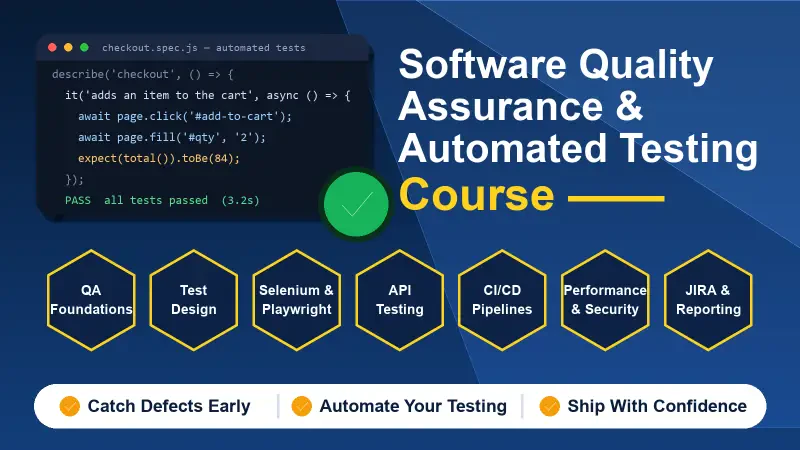
Software Quality Assurance and Automated Testing Course
The Software Quality Assurance and Automated Testing Course is a 5-day professional training programme delivered in-person or online in ICT-Information & Communication Technology, ending with a TrustGate Corporate Skills certificate of completion.
This programme equips participants with the knowledge and practical skills to assure software quality across the development lifecycle and to design, build and maintain automated test suites. It covers quality standards and processes, test planning and design techniques, manua...
Last updated
Course Overview
Learning Objectives
- Explain software quality assurance concepts, standards and the role of QA across the software development lifecycle.
- Develop test strategies, test plans and test cases using recognised test design techniques.
- Execute manual functional, regression, usability and exploratory testing and report defects effectively.
- Design and build automated test scripts for web applications using tools such as Selenium and Playwright.
- Test APIs and services with Postman and automate API regression checks.
- Integrate automated tests into CI/CD pipelines for continuous testing.
- Carry out basic performance and security testing and interpret the results.
- Manage testing work, defects and traceability with tools such as JIRA, and report quality using metrics and dashboards.
Course Content
- Quality assurance, quality control and testing: roles and boundaries.
- The cost of poor quality and the business case for QA.
- QA across the SDLC: waterfall, agile and DevOps delivery.
- Standards and vocabulary: ISO/IEC 25010 quality characteristics and ISTQB terms.
- Quality gates, entry and exit criteria.
- Test policy, test strategy and the test plan.
- Risk-based testing and prioritisation.
- Equivalence partitioning and boundary value analysis.
- Decision tables, state transition and use-case testing.
- Requirements traceability and coverage.
- Functional, regression, smoke and sanity testing.
- Exploratory and usability testing sessions.
- Writing clear, reproducible defect reports.
- Defect lifecycle, severity and priority.
- User acceptance testing with business stakeholders.
- Organising test cycles, suites and test data.
- Managing testing work and defects in JIRA.
- Quality metrics: coverage, defect density, defect escape rate.
- Dashboards and reporting to project leadership.
- Documentation that auditors and clients expect.
- What to automate and what to keep manual: the automation pyramid.
- Selecting automation tools and frameworks.
- Setting up the automation environment.
- Locators and selectors: finding elements reliably.
- Writing a first automated test.
- Writing and structuring automated web tests.
- Waits, synchronisation and flaky-test prevention.
- The page object model and reusable components.
- Data-driven and cross-browser testing.
- Organising and running automated suites.
- HTTP and REST fundamentals for testers.
- Postman collections, environments and variables.
- Assertions and test scripts for API responses.
- Automating API regression suites.
- Mocking and testing integrations.
- Version control essentials for QA teams.
- Running automated suites in pipelines (GitHub Actions, Jenkins).
- Test reports, failure triage and re-runs.
- Quality gates that block bad releases.
- Shift-left testing and developer collaboration.
- Load, stress and endurance testing concepts.
- Building and running tests with JMeter.
- Interpreting response times, throughput and error rates.
- Security testing basics and the OWASP Top 10 for testers.
- Reporting performance and security findings.
- Building a test strategy for a case application.
- Implementing combined manual and automated coverage.
- Running the suite in a pipeline and reading the results.
- Presenting quality status to stakeholders.
- Personal action plan for applying QA at work.
Who Should Attend?
- Software testers and quality assurance officers.
- Developers who want to strengthen their testing and automation skills.
- ICT officers and systems administrators responsible for software quality.
- Business analysts and product owners involved in user acceptance testing.
- Project managers and team leads overseeing software projects.
- Computer science and IT students preparing for QA and testing roles.
Training Methodology
- Instructor-led demonstrations.
- Hands-on testing and automation laboratories.
- Real application case studies.
- Group exercises and peer test reviews.
- A guided end-to-end course project.
- Post-training support.
Is this course for you?
Level: Intermediate
Problems this course solves
- Defects reaching production: builds structured testing that catches issues before release.
- Slow, repetitive manual testing: introduces automation that shortens release cycles.
- Unclear quality status: establishes metrics, dashboards and reports leadership can act on.
- Fragile releases: embeds continuous testing in CI/CD so every change is checked.
- Weak test documentation: standardises test plans, cases and defect reports.
What's Included
Certification
Certificate in Software Quality Assurance and Automated Testing
Issued by: TRUSTGATE CORPORATE SKILLS
Frequently Asked Questions
How long is the Software Quality Assurance and Automated Testing Course training?
The Software Quality Assurance and Automated Testing Course runs for 5 Days. Each day combines expert-led teaching with practical, hands-on exercises so participants can apply what they learn immediately.
Is the Software Quality Assurance and Automated Testing Course delivered online or in-person?
This course is delivered in person (scheduled venues include Mombasa, Nairobi, Kigali, Arusha), live online, or in-house at your organisation.
How much does the Software Quality Assurance and Automated Testing Course cost?
The fee is US$600 per person online and US$1,400 per person in person. In-person fees depend on the participant's country; the pricing card on this page shows the fee for yours.
When is the next Software Quality Assurance and Automated Testing Course training?
A session is running now, from 23 November 2026 to 27 November 2026 in Mombasa, Kenya / Nairobi, Kenya. The next one runs from 30 November 2026 to 4 December 2026 in Kigali, Rwanda. You can also request a custom date or an in-house session for your team.
Do I get a certificate after completing the Software Quality Assurance and Automated Testing Course?
Yes. Participants who complete the Software Quality Assurance and Automated Testing Course receive a certificate of completion from TRUSTGATE CORPORATE SKILLS.
What will I learn in the Software Quality Assurance and Automated Testing Course?
Key learning outcomes include: Explain software quality assurance concepts, standards and the role of QA across the software development lifecycle; Develop test strategies, test plans and test cases using recognised test design techniques; Execute manual functional, regression, usability and exploratory testing and report defects effectively; Design and build automated test scripts for web applications using tools such as Selenium and Playwright; Test APIs and services with Postman and automate API regression checks.