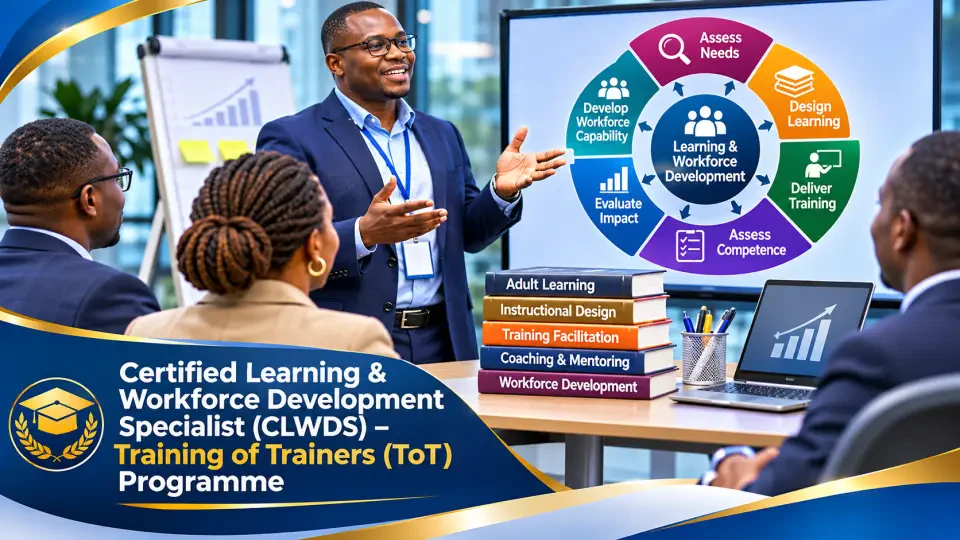
Certified Learning & Workforce Development Specialist (CLWDS) – Training of Trainers (ToT) Programme
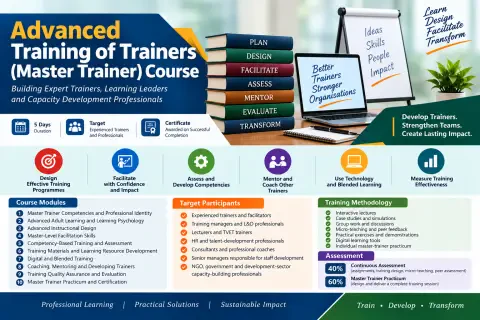
The Certified Learning & Workforce Development Specialist (CLWDS) – Training of Trainers (ToT) Programme is a 5-day professional training programme delivered in-person or online in Training of Trainers (TOT), ending with a TrustGate Corporate Skills certificate of completion.
Organizations need learning professionals who can translate business and workforce requirements into measurable capability and performance improvement. Effective Learning & Development therefore goes beyond delivering training; it requires professionals who can diagnose skills...
Course Overview
Learning Objectives
- Align Learning & Development initiatives with organizational strategy and workforce priorities.
- Diagnose organizational, occupational and individual learning needs.
- Conduct systematic Training Needs Assessments and competency-gap analyses.
- Distinguish training needs from wider performance and organizational problems.
- Apply adult-learning principles to professional and workplace training.
- Design competency-based learning programmes and interventions.
- Develop measurable learning outcomes, course structures and session plans.
- Apply professional facilitation and learner-engagement techniques.
- Use experiential and participatory learning methodologies effectively.
- Develop valid and appropriate learner assessment tools.
- Evaluate learner competence and provide developmental feedback.
- Apply coaching and mentoring approaches to workforce development.
- Improve transfer of learning from training environments to the workplace.
- Design digital, virtual and blended learning interventions.
Course Content
- Strategic Role of Learning & Development – Understanding L&D as a driver of organizational capability, adaptability and performance.
- Aligning Learning with Organizational Strategy – Translating strategic priorities and business objectives into workforce learning requirements.
- Workforce Capability & Competency Development – Identifying and developing the knowledge, skills and behaviour required for current and future roles.
- Building a Continuous Learning Culture – Creating organizational conditions that encourage lifelong learning, knowledge sharing and continuous improvement.
- Principles of Adult Learning – Applying adult-learning principles to workplace and professional development programmes.
- Learner Motivation & Engagement – Understanding factors influencing participation, motivation, retention and application of learning.
- Learner Diversity & Inclusive Learning – Addressing differences in experience, ability, learning preferences and professional backgrounds.
- Creating Effective Learning Environments – Establishing psychologically safe, participatory and performance-oriented learning environments.
- Training Needs Assessment (TNA) – Conducting organizational, occupational and individual-level learning needs assessments.
- Competency & Skills Gap Analysis – Comparing required workforce competencies against existing capability.
- Performance Gap Diagnosis – Determining whether performance deficiencies require training or alternative organizational interventions.
- Prioritizing Workforce Development Needs – Using organizational impact, urgency, strategic relevance and resource considerations to determine learning priorities.
- Instructional Design Using ADDIE – Applying analysis, design, development, implementation and evaluation systematically.
- Developing Learning Outcomes – Creating measurable competency and performance-oriented learning outcomes.
- Applying Bloom's Taxonomy – Designing learning activities and assessments across appropriate cognitive levels.
- Course, Session & Learning Material Design – Developing coherent course outlines, session plans, participant materials and trainer resources.
- Professional Facilitation Skills – Developing trainer presence, credibility, communication and learner-centred facilitation.
- Presentation & Communication Techniques – Structuring presentations and communicating complex information clearly and confidently.
- Questioning, Listening & Feedback Skills – Using purposeful questions, active listening and constructive feedback to deepen learning.
- Managing Challenging Training Situations – Handling difficult participants, resistance, dominant personalities, low participation and group dynamics.
- Experiential Learning Techniques – Designing learning through experience, reflection, conceptualization and workplace application.
- Case Studies, Simulations & Role Plays – Creating realistic learning experiences that develop practical decision-making skills.
- Problem-Based & Action Learning – Using real organizational challenges as vehicles for learning and capability development.
- Competency-Based Training Methods – Designing learning around demonstrable workplace knowledge, skills, behaviours and performance standards.
- Formative & Summative Assessment – Selecting appropriate assessment approaches at different stages of learning.
- Developing Assessment Tools – Designing tests, observation instruments, practical exercises, rubrics and competency checklists.
- Assessing Workplace Competence – Evaluating whether participants can demonstrate required competencies in realistic contexts.
- Feedback, Evidence & Assessment Records – Providing developmental feedback and maintaining credible evidence of learner achievement.
- Training, Coaching & Mentoring – Selecting the appropriate development intervention for different employee and organizational needs.
- Workplace Coaching Techniques – Applying structured coaching conversations to improve employee capability and performance.
- Designing Effective Mentoring Programmes – Supporting knowledge transfer, professional development and career progression.
- Learning Transfer & Continuous Development – Reinforcing new competencies through workplace practice, manager support and development planning.
- Training Evaluation Frameworks – Applying Kirkpatrick's Four Levels and other approaches to evaluate learning interventions.
- Learning & Development KPIs – Developing indicators for participation, learning, behaviour, performance and organizational outcomes.
- Measuring Workplace Performance Impact – Establishing whether learning interventions produce measurable changes in employee and organizational performance.
- Training ROI & Stakeholder Reporting – Assessing learning investment value and communicating evidence-based results to management and stakeholders.
- Digital, Virtual & Blended Learning – Designing effective learning experiences across physical and digital environments.
- Learning Technologies & LMS – Using Learning Management Systems, collaboration platforms and digital resources to manage and enhance learning.
- Artificial Intelligence in Learning & Workforce Development – Applying AI responsibly to needs analysis, content development, personalization, assessment and learning analytics.
- CLWDS Trainer Practicum & Competency Demonstration – Designing and delivering a professional training session followed by peer review, facilitator assessment and structured developmental feedback.
Who Should Attend?
- Learning & Development managers and specialists.
- Human Resource managers and HR professionals.
- Corporate trainers and professional facilitators.
- Training managers, officers and coordinators.
- Workforce planning and development professionals.
- Talent management and organizational development specialists.
- TVET trainers, instructors and lecturers.
- Capacity-building and institutional-development professionals.
- Managers and supervisors responsible for developing employees.
- Training consultants and independent facilitators.
- Coaches and mentors.
- Subject-matter experts required to train other professionals.
- Learning programme and curriculum developers.
- Professionals transitioning into Learning & Development or corporate training roles.
Training Methodology
- Facilitator-led interactive presentations.
- Guided professional discussions.
- Real organizational and workplace case studies.
- Individual and group exercises.
- Training Needs Assessment exercises.
- Competency and skills-gap analysis.
- Instructional-design workshops.
- Course and session-plan development.
- Role plays and workplace simulations.
- Problem-based learning activities.
- Experiential and action-learning exercises.
- Group presentations and peer learning.
- Assessment-tool development.
- Coaching and mentoring simulations.
- Digital learning demonstrations.
- AI-supported L&D exercises.
- Micro-teaching sessions.
- Peer assessment and structured feedback.
- Facilitator competency assessment.
- Personal workplace action planning
Is this course for you?
Problems this course solves
- Learning programmes that are disconnected from organizational strategy.
- Failure to identify genuine workforce capability and competency gaps.
- Training interventions based on assumptions rather than systematic needs assessment.
- Confusion between training problems and broader performance problems.
- Poorly designed training programmes and learning materials.
- Learning objectives that cannot be meaningfully assessed.
- Weak trainer presentation and facilitation capabilities.
- Low learner participation, engagement and knowledge retention.
- Overdependence on lecture-based training.
- Difficulty managing diverse adult-learning environments.
- Weak competency assessment and learner-feedback practices.
- Poor transfer of acquired skills to workplace performance
What's Included
Certification
Certificate in Certified Learning & Workforce Development Specialist (CLWDS) – Training of Trainers (ToT)
Issued by: TRUSTGATE CORPORATE SKILLS
Frequently Asked Questions
How long is the Certified Learning & Workforce Development Specialist (CLWDS) – Training of Trainers (ToT) Programme training?
The Certified Learning & Workforce Development Specialist (CLWDS) – Training of Trainers (ToT) Programme runs for 5 Days. Each day combines expert-led teaching with practical, hands-on exercises so participants can apply what they learn immediately.
Is the Certified Learning & Workforce Development Specialist (CLWDS) – Training of Trainers (ToT) Programme delivered online or in-person?
This course is delivered in person (scheduled venues include Mombasa, Nairobi, Kigali, Lilongwe), live online, or in-house at your organisation.
How much does the Certified Learning & Workforce Development Specialist (CLWDS) – Training of Trainers (ToT) Programme cost?
The fee is US$600 per person online and US$1,400 per person in person. In-person fees depend on the participant's country; the pricing card on this page shows the fee for yours.
When is the next Certified Learning & Workforce Development Specialist (CLWDS) – Training of Trainers (ToT) Programme training?
The next scheduled session runs from 16 November 2026 to 20 November 2026 in Mombasa, Kenya. You can also request a custom date or an in-house session for your team.
Do I get a certificate after completing the Certified Learning & Workforce Development Specialist (CLWDS) – Training of Trainers (ToT) Programme?
Yes. Participants who complete the Certified Learning & Workforce Development Specialist (CLWDS) – Training of Trainers (ToT) Programme receive a certificate of completion from TRUSTGATE CORPORATE SKILLS.
What will I learn in the Certified Learning & Workforce Development Specialist (CLWDS) – Training of Trainers (ToT) Programme?
Key learning outcomes include: Align Learning & Development initiatives with organizational strategy and workforce priorities; Diagnose organizational, occupational and individual learning needs; Conduct systematic Training Needs Assessments and competency-gap analyses; Distinguish training needs from wider performance and organizational problems; Apply adult-learning principles to professional and workplace training.