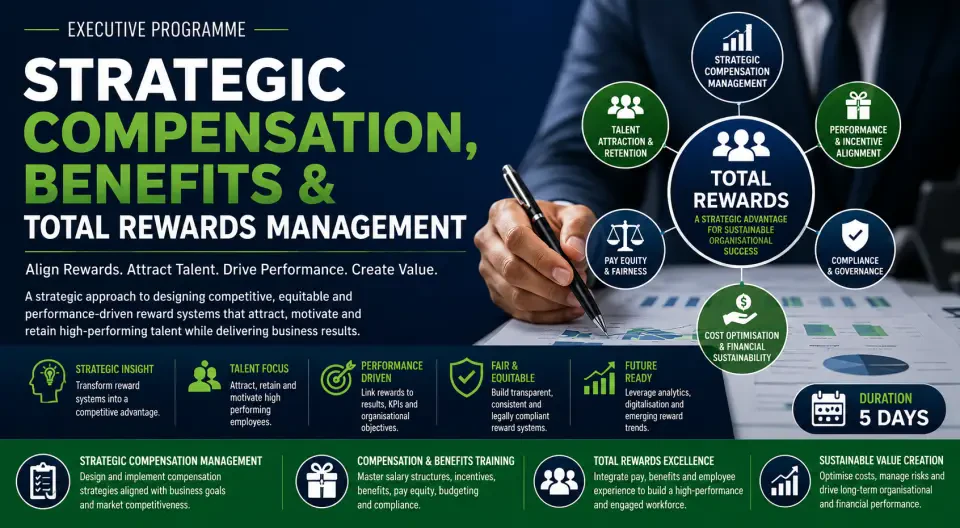
Executive Programme in Strategic Compensation, Benefits and Total Rewards Management
The Executive Programme in Strategic Compensation, Benefits and Total Rewards Management is a 10-day professional training programme delivered in-person or online in Human Resource Management, ending with a TrustGate Corporate Skills certificate of completion.
The Executive Programme in Strategic Compensation, Benefits and Total Rewards Management is designed to equip HR leaders, executives, managers and reward professionals with the strategic capabilities required to transform compensation from an administrative function into a hig...
Last updated
Course Overview
Learning Objectives
- Formulate strategic compensation and total rewards strategies aligned with organisational objectives.
- Evaluate the strategic contribution of compensation to talent attraction, retention and organisational performance.
- Develop integrated salary structures, grades, bands and pay architectures.
- Apply job evaluation principles to strengthen internal equity and pay consistency.
- Conduct compensation benchmarking and determine appropriate market positioning.
- Design performance-based pay and incentive systems aligned with organisational KPIs.
- Develop sustainable employee benefits and total rewards packages.
- Identify and address pay equity, fairness and discrimination risks.
- Integrate compensation planning with workforce planning and organisational budgeting.
- Use compensation analytics to support strategic management decisions.
- Evaluate emerging compensation trends and their implications for organisational strategy.
- Develop a strategic roadmap for strengthening the organisation's total rewards architecture.
Course Content
- Compensation as a strategic business function
- Linking rewards to organisational strategy
- Total rewards architecture
- Compensation and the employee value proposition
- Strategic reward challenges facing modern organisations
- Strategic job evaluation
- Job classification and grading
- Salary grades and pay bands
- Internal equity
- Pay architecture governance
- Compensation market intelligence
- Salary surveys and benchmarking
- Selecting appropriate market comparators
- Market positioning strategies
- Using external pay data for strategic decisions
- Strategic performance-based pay
- Incentive architecture
- Short- and long-term incentives
- Bonus and reward mechanisms
- Linking rewards to organisational value and performance
- Benefits strategy
- Benefits optimisation
- Flexible and personalised benefits
- Cost-benefit analysis
- Employee value proposition and retention
- Pay equity and organisational justice
- Identifying compensation disparities
- Pay gap analysis
- Fairness and transparency
- Governance of remuneration decisions
- Strategic compensation budgeting
- Workforce cost modelling
- Payroll cost management
- Compensation forecasting
- Cost optimisation and sustainability
- Compensation-related legal and regulatory risks
- Remuneration policies and governance
- Documentation and accountability
- Compensation audits
- Managing remuneration disputes and risk
- Compensation analytics
- Reward KPIs
- Pay equity analytics
- Workforce cost analytics
- Data-driven reward decisions
- Compensation dashboards
- Communicating compensation strategy
- Reward transparency
- Managing employee expectations
- Executive-level reward communication
- Managing sensitive remuneration conversations
- Implementing reward transformation
- Skills-based and competency-based pay
- Flexible and personalised rewards
- Hybrid-work reward strategies
- Digital transformation of compensation
- Artificial intelligence in reward management
- Future trends in total rewards
Who Should Attend?
- HR Directors, Heads of HR and HR Managers
- Strategic HR Business Partners
- Compensation and Benefits Managers and Specialists
- Total Rewards and Remuneration Professionals
- Talent Management and Organisational Development Managers
- Performance Management Professionals
- Payroll and Rewards Managers
- Finance Directors, Finance Managers and Budget Officers
- Senior Managers and Departmental Heads
- Chief Executive Officers and Executive Management Teams
- Public Sector HR and Remuneration Officers
- Human Capital and Workforce Planning Professionals
- Employee Relations and Industrial Relations Managers
- Recruitment and Talent Acquisition Managers
- HR Analytics and People Analytics Professionals
- Organisational Development and Employee Experience Professionals
- HR Consultants, Reward Consultants and Management Advisors
- Professionals responsible for remuneration policy, salary structures and benefits administration
- Members of remuneration, HR, audit and governance committees
Training Methodology
- Strategic compensation case studies
- Salary structure design
- Job evaluation exercises
- Market benchmarking simulations
- Incentive scheme design
- Pay equity analysis
- Benefits optimisation exercises
- Compensation budget scenarios
- Workforce cost analysis
- Compensation analytics
- Executive reward strategy presentations
- Development of an organisational Total Rewards Strategic Action Plan
What's Included
Certification
Certificate in Strategic Compensation, Benefits and Total Rewards Management
Issued by: TRUSTGATE CORPORATE SKILLS
Frequently Asked Questions
How long is the Executive Programme in Strategic Compensation, Benefits and Total Rewards Management training?
The Executive Programme in Strategic Compensation, Benefits and Total Rewards Management runs for 10 Days. Each day combines expert-led teaching with practical, hands-on exercises so participants can apply what they learn immediately.
Is the Executive Programme in Strategic Compensation, Benefits and Total Rewards Management delivered online or in-person?
This course is delivered in person (scheduled venues include Nairobi, Mombasa, Kigali, London), live online, or in-house at your organisation.
How much does the Executive Programme in Strategic Compensation, Benefits and Total Rewards Management cost?
The fee is US$1,200 per person online and US$2,800 per person in person. In-person fees depend on the participant's country; the pricing card on this page shows the fee for yours.
When is the next Executive Programme in Strategic Compensation, Benefits and Total Rewards Management training?
The next scheduled session runs from 9 November 2026 to 20 November 2026 in Nairobi, Kenya. You can also request a custom date or an in-house session for your team.
Do I get a certificate after completing the Executive Programme in Strategic Compensation, Benefits and Total Rewards Management?
Yes. Participants who complete the Executive Programme in Strategic Compensation, Benefits and Total Rewards Management receive a certificate of completion from TRUSTGATE CORPORATE SKILLS.
What will I learn in the Executive Programme in Strategic Compensation, Benefits and Total Rewards Management?
Key learning outcomes include: Formulate strategic compensation and total rewards strategies aligned with organisational objectives; Evaluate the strategic contribution of compensation to talent attraction, retention and organisational performance; Develop integrated salary structures, grades, bands and pay architectures; Apply job evaluation principles to strengthen internal equity and pay consistency; Conduct compensation benchmarking and determine appropriate market positioning.